
Every winter we get the same call from the foothills. The door was fine, then one cold morning it started struggling. It opens slowly, the opener sounds like it is straining, and sometimes it stops halfway.
Nothing broke. The temperature dropped, and a garage door is a machine that cares about temperature more than most people realise.
What Cold Actually Does
Three things happen at once.
Steel contracts. Metal shrinks as it cools. A garage door track, the rollers running in it, and the hinges connecting the sections all get very slightly smaller and tighter. Individually that is nothing. Together it adds friction across the whole system.
Grease thickens. Whatever lubricant is on the rollers, hinges and spring coils gets stiffer in the cold. Old lubricant that has picked up dust and grit becomes something closer to paste. The parts that should glide start dragging.
Springs lose a little help. A torsion spring works by storing energy when the door closes and giving it back when the door opens. Spring steel is slightly less responsive when cold, so the spring returns a bit less than it does in warm weather.
None of these is dramatic on its own. Stacked together on a twenty degree morning, the door your opener lifted easily in October is now noticeably heavier.
Why the Foothills Feel It More
Elevation matters. North Bend sits at the foot of Mount Si, and Snoqualmie is not far behind it. Cold air comes down off the pass and settles in overnight. Granite Falls and Issaquah sit against the foothills too.
Even the plateau towns run colder than the valley floor. Covington and Bonney Lake sit several hundred feet above the river valleys nearby, and that difference shows up on winter mornings.
A door in the Kent valley and a door in North Bend can be identical hardware and behave differently on the same January morning.
What You Will Notice First
The door opens slower than it used to, particularly the first cycle of the day.
The opener sounds strained. Some openers will start and stop, because the motor hits its force limit and backs off. That is the safety system working, not the opener failing.
The door stops partway and reverses. Same reason.
The bottom seal is stuck to the concrete. This one is separate from the rest. Moisture under the seal freezes overnight and glues the door to the slab. The opener pulls, the seal holds, and either the seal tears or the opener gives up.
What Actually Helps
Get the balance checked before winter. This is the one that matters most. A properly balanced door should stay put when you lift it halfway by hand with the opener disconnected. If it drops or climbs, the spring tension is off, and cold will make that worse rather than better. Spring tension set in August is not necessarily right in January.
Clean and relubricate. Old grease with grit in it is worse than no grease. Wipe the rollers and hinges down, then apply fresh garage door lubricant. Do this in autumn and the door goes into winter with a clean film on the moving parts.
Do not use WD-40 for this. It is a solvent, it displaces water but it also strips existing lubricant and leaves the metal bare. Use a garage door lubricant, or a silicone or lithium based spray.
Check the bottom seal. A worn or hardened seal is more likely to freeze to the slab. If it is cracked or flattened, replace it before the cold sets in. Sweeping water away from the opening helps too.
Do not fight a frozen door with the opener. If the seal is stuck, forcing it with the motor will either tear the seal or strain the opener. Break the seal free by hand first.
What Not to Do
Do not adjust the spring tension yourself. A torsion spring holds enough energy to break bones. This is the one garage door job that genuinely needs a professional with the right bars and the training to use them.
Do not turn up the opener's force setting to push through the resistance. The force limit is a safety feature. Overriding it means the door will not reverse when it should, and it hides the underlying problem rather than fixing it.
When to Call
If the door has become noticeably heavier to lift by hand, the balance needs checking.
If the opener is stopping and reversing regularly, something is adding resistance and forcing past it is not the answer.
If you hear a bang from the garage and the door will not open, that is a spring, and it is not a repair to attempt yourself.
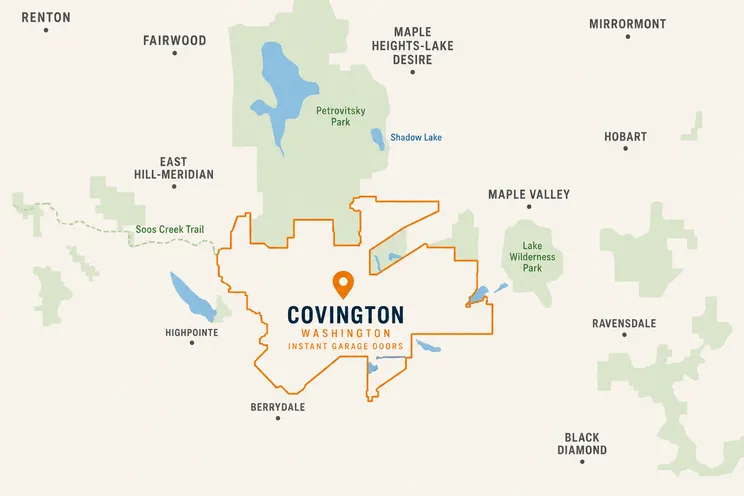
We cover the foothills from Granite Falls in the north down through Issaquah, Snoqualmie and North Bend, and out to Covington and Bonney Lake. Our trucks carry the common spring sizes, so most jobs are done in one visit, and you get the price before we start.
We cover the foothills corridor





01 Why does my garage door only struggle in the morning?
The garage is at its coldest overnight. Steel has contracted, lubricant has stiffened, and the spring is at its least responsive. By afternoon the temperature has come up and the door often runs normally again.
02 Does cold weather actually break springs, or just make them feel heavy?
Cold does not break a healthy spring on its own. It adds load to a spring that was already near the end of its life, which is why more spring failures happen in winter.
03 My door is frozen to the ground. What should I do?
Do not use the opener. Break the seal free by hand, working along the bottom, then check the seal for damage once the door is open. Clearing water away from the opening helps prevent it happening again.
04 Should I turn up the force setting on my opener in winter?
No. The force limit stops the door crushing something in its path. Raising it to push through resistance removes that protection and masks whatever is actually wrong.
Door Struggling on Cold Mornings?
Schedule a balance check and seasonal tune-up before winter sets in
Serving the foothills from Granite Falls to Bonney Lake. Available 24/7 for emergency service.